Thursday, February 20, 2014

Selective Focus for Impact

 600mm lens @ f 4
300mm lens @ f2.8
 
      There are lots of ways to add impact to our images, but my personal favorite may well be the simplest. Shooting in Aperture Priority Mode is a great way to control backgrounds and force the viewers eye immediately to your primary subject. Opening your lens' aperture to its' widest setting will cause your photos background to go soft and concentrate the focus on the main subject of the image. For me, that generally means that my birds are going to be sharply focused, while my backgrounds are going to appear extremely soft. Nothing really earthshaking here, as portrait photographers have been using this technique since the beginning of time. While landscape shooters tend to want everything in the image in sharp focus, lots of wildlife photographers seek just the opposite.
      Your lens are going to dictate just how well you can execute this technique. Better lens have wider aperture settings, and that translates to even softer backgrounds. There's a good reason we pay more for lens with openings of 1.4 to 2.8. They focus faster, and they simply give better results. However, experiment with whatever you have in your bag, and I think you'll be surprised with the results. Happy Shooting. 


Wednesday, February 19, 2014

Ask Yourself The Basic Question

     I have often been asked for advice in helping amateur photographers make the leap from hobby to professional photographer. This is a difficult one for me to answer, as my answer is not usually what people want to hear. But.....as they say, "The truth will set you free."
      Let me begin by saying that very few individuals should actually contemplate such a move. Quite frankly, the odds are stacked against you, and most will be completely shocked by the capital investment that must be made if you want to succeed. I'm not talking about cameras and lenses, as that is what most amateurs focus on in the beginning. The real expenses come from travel and exhibition fees, not to mention printing supplies. Those things alone would bring many to their senses. Even more.....it's the dedication and the time one devotes to the craft that can be daunting.
      We all tend to think we have great images that others will want to purchase. Sadly, this is not actually the case for most photographers. Often what we think is great, well, it's not "great" to the general public. That incredible image you have that makes you weep at the sight of its' beauty, might get zero reaction from the general public (the folks with the money in their wallets). My experience is that most photographers, and that includes really good photographers, haven't got a clue as to what images will succeed in the marketplace. How many times have I seen young photographers fail, not because they aren't good photographers, but because they are lousy editors. While they may have countless images in their files, they just can't seem to pick out the right images for display and sales.
      So, let's now get to the big question. Do I love this thing called photography? Do I love it so much that I can't live without it? Do I love it so much that I'm willing to take huge risks to make it happen for me? Do I love it enough to spend most of my time "working" at it? Finally, Do I love it enough to be open to failure? Passion does not always translate to success. We need to know this going into any adventure. Photography is no different.
       I love seeing individuals succeed in life. I especially love seeing artists succeed. Success is not something we are promised in life......it is something we earn through hard work, and it is often attached to a kind heart. My advice........Dream large, Work hard, and let your heart be gentle in all things. Good Luck. 

Wednesday, February 12, 2014

The Moment of Capture


        Sometimes a click of the shutter just doesn't tell the whole story. Even with the best of gear, it's ultimately the eye of the photographer that makes or breaks a photograph. Luck rarely plays any major role in a meaningful image. Planning and persistence are far more significant than the luck of being in the right place at the right time.
        This image was taken a few days ago in a location that I have been visiting for several years. This exact spot has been a favorite of mine, and it's been a location that calls to me often. I can't begin to tell you how many sunsets I have witnessed in this precise spot. Some have been beautiful, while others have been disappointing, but all have been important in making "this" photograph. What I have learned through countless shoots have taught me lessons enabling me to make this image possible. Because of previous successes and failures, I came prepared for this image with the right lens and the knowledge needed to make this exposure. Experience does count, and practice does make perfect. Pushing yourself toward perfection can be a tough road, but the end of the road can be an incredible adventure. We all have it within us to improve and grow, and it's our personal challenge to follow our own road to success. It's time to start your journey. I wish you success. 

Monday, February 3, 2014

Shooting White...exposure issues and more
 
 
        As many photographers can tell you, it can be very difficult to get great shots, when much of your frame is filled with white or near white. Modern exposure meters in our DSLR cameras are programed to balance our exposures in a manner that tends to underexpose images like the one above. The camera's meter sees the image and immediately decides the image is too bright, and then underexposes it in a way that it thinks is going to give us a better image. However, what we end up with is an image that is often at least two full stops under what is needed to record the image as we see it in the moment of capture.
        The solution is a simple one......we need to set our exposure compensation dial for +2 stops, and we end up with the correct exposure for the scene. No great brain drain here, but something we need to remember. Of course, shooting in RAW can make this correction a simple task. If you're shooting in jpeg format, however, you'll need to keep this in mind at all times.
 
 
         With the image above, the reverse is true. The meter reads the majority of the frame as being dark and tries to lighten the image by opening the exposure by one or two stops. The result is that the whites get over exposed, or sometimes referred to as "blown out." By setting the exposure compensation dial to minus one or two stops, this type of image is once again properly exposed.
 
Final Thoughts:  Too many photographers are just plain sloppy with their exposures. The digital age of photography has made it far to easy to "correct things after the exposure is taken." I believe that is a huge mistake. There is just no replacement to hitting the exposure on the head with the original image. Your photos will be so much richer in so many ways if you take the time to do it right the first time. If you really want quality images, then you need to put forth the effort to nail the exposure. Don't be one of the "sloppy" photographers. We have far too many of them amongst us already.


Experimenting With Still Life


      I'm always looking for new ways to highlight my feathered friends, and lately I've been having some fun with a radio frequency remote shutter release. This is one of the toys that I've looked at for years, but only recently added to my arsenal of photographic tools. It simply enables us to capture images, while not actually sitting in front of the camera. From the comfort of my favorite leather chair, I can activate the shutter and capture images that would be nearly impossible any other way.
     My son-in-law, without knowing he was doing so, inspired me to experiment with some still life scenes. He recently had an assignment to create some still life images for his employer, and I was blown away by their beauty. That lead me to begin thinking along those same lines regarding my own work. How could I put my love for birds together with the beauty of a classic still life image.
     I ended up putting together a grouping of some antique objects that I've collected, and placed them in a setting of soft light ..........and then introduced some "bird seed." It didn't take long until I had attracted a suitable subject, which resulted in the image above. From the comfort of my (indoor) chair I clicked the shutter, and I'm now thinking about all sorts of new uses for my remote shutter release. Watch for some interesting images in the weeks to come. 

Saturday, July 27, 2013

What Makes a Winner?

 
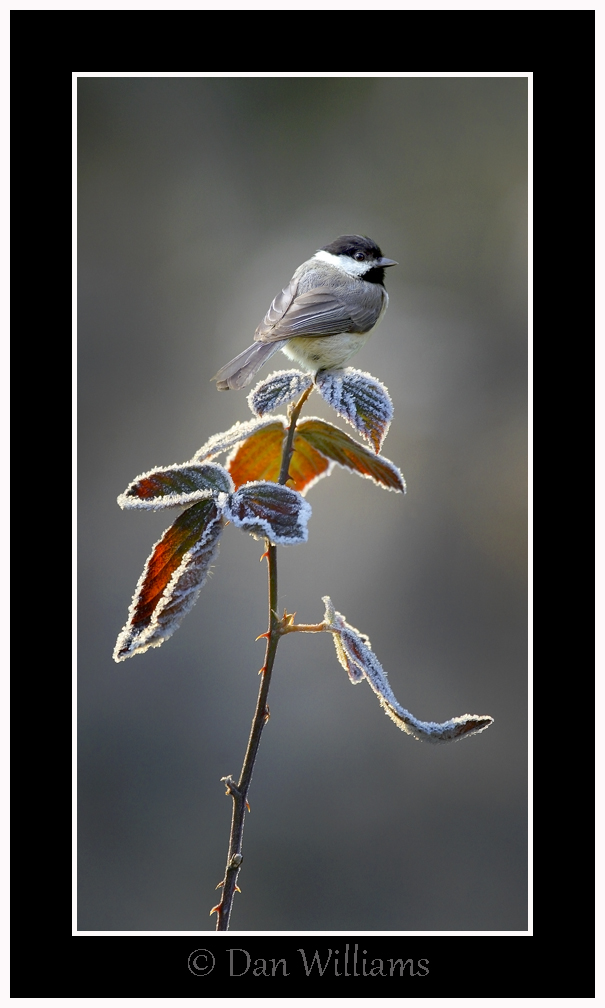
     What you see above is a photograph that I took several years ago. It was captured early one winter morning in a pasture area that adjoins my yard. It's one of those photos that I didn't have to work very hard to get, but it has been one of the most popular images in my entire collection of bird photographs. In fact, it would easily rank in the top five selling images within my entire library of photos. But, why this image?
      I'm  making this post as a result of so many requests from photographers. I get this question all the time. "Why are your images so popular with the public, and why do some of your shots continue to sell year after year?" Well, that's a tough one, and it's not a question that I can fully answer here in a few short paragraphs. But, I might shed some light on the subject by simply discussing this image.....a classic shot of a Chickadee.
      As most of us know, good photography starts with good light. Directional light is imperative to any successful image. Without a strong sense of light, most images lack what I call "punch." Light is what sets the mood of a photo, and without it an image cannot tell a complete story to the viewer. Simply put.....this backlit image has punch.
      This image also has a wonderful tonality about it. The soft shades of gray become defined by the warm tones of red and orange that appear in the frozen blackberry branch. Without these hues of color, the image would appear flat and not nearly as interesting to the eye. Also, the frost on the leaves catch the light and further define the branch by increasing the overall contrast within the composition. It's actually the frost that helps the viewer identify the light source.
      Finally, the small Chickadee presents us with a focal point, but it does so without "stealing the show." What do I mean by that statement? For years now, I have worked hard at creating images that show us birds in a way that allows us to appreciate nature, and I mean all of nature. Sometimes a clump of weeds can be just as interesting as a colorful hummingbird. Sometimes that which surrounds our subject......becomes our subject. In the image above, our little chickadee shares the spotlight with a simple frozen blackberry branch. Both equally share the spotlight. While the softness of the bird stands in dramatic contrast to the icy, thorn covered branch, they actually compliment each other in a way that only nature can show us.
      So....back to our original question. Put another way, "Why has this image remained so popular for so many years?" My best guess is this......It's a wonderfully simple composition that doesn't confuse the viewer with distracting elements for the sake of  "detail." Its' limited color palette is calming to our senses. It's frosty leaves make us feel winter, but its' powerful morning light gives us hope for a warmer day. This image shares its' story without making us dig too deep, and I suspect it will be doing just that for many decades to come.
       Let me end with this. Fine art photography is a tough field. It's highly competitive, and that's a good thing for all of us. Success is this field is measured in so many different ways, but for those of us who support our families with our images, sales cannot be ignored. Photographers can improve their personal sales by elevating the quality of their images. Sharp, clear, vibrant "snapshots" cannot compete in this field of endeavor. The public wants more, and successful photographers are presenting images that reach a much higher standard. I would encourage everyone to have a good hard look at your own images and assess if they are individually telling a complete story. If not.....work is needed. Good Luck. 

Wednesday, June 19, 2013

Shooting Hummingbirds

 
      As many of you already know, I spend allot of time photographing hummingbirds. They have long been one of my favorite species, and I love the challenge of catching them in flight. Thankfully, digital imaging has made the task much easier than just a few years ago. Thanks to the development of increasing low noise digital sensors, we now have the ability to shoot images at very high iso's with very little digital noise. Those higher iso's have enable us to shoot at incredibly high shutter speeds, which are demanded by this kind of photography. Typically, I shoot hummers at 1600 iso, and I try to achieve a shutter speed of between 1/2000 th of a sec. to perhaps 1/4000th of a sec. The shot above falls somewhere in the middle.
      I'm often ask if I use either a flash or filters to get the job done. The answer is neither, as I don't like the effect of a flash, nor do I like filters, as I think they tend to degrade my images. I try in all cases to capture my images without adding anything to the lens or lighting. I just feel it gives a more natural feeling to the photograph. Others may disagree.....this is simply my personal approach.
      Fortunately, I live in an area of the country where we are blessed with lots of hummingbirds. My gardens are generally buzzing with them all summer. However, that is not to say that I don't employ the use of feeders to attract even more. In fact, I have lots of feeders that can be easily moved around the gardens. These feeders are extremely helpful in bringing the hummers to areas of the garden that have the most flowers in bloom. The above photo came about by moving several hummingbird feeders into a area of the garden filled with Iris. While hummers aren't especially attracted to Iris' for feeding, my feeders brought the birds to the Iris and I managed to capture some interesting images. Very few photos come from luck alone. Good photos are generally well planned in advance, and then executed with skill and patience........at least that is my take on it. Enjoy your photography.

Saturday, June 15, 2013

Revisiting Old Photos


        It's time to have another look at some of our old photos. Images that you may have stored away, thinking they weren't up to par, may surprise you when you reprocess them with new updated software. Lately, I have been going through some of my older files and taking a second look at images that disappointed me just a few years ago. Fortunately, I still have many of those images, and I am now thrilled with them, after seeing them reprocessed with todays' software. If you haven't tried this yet, don't wait any longer. Some of those images that are buried deep in your old folders may turn out to be some of your new prize winners.
 
       The latest versions of software converters make it easy and efficient to get the most from our files. For example, the latest version of Lightroom (Adobe) can take an old file and make it sparkle. With all of the software improvements, you won't believe the quality that has been hiding within your files. Could well be that you're a better photographer than you think. I suggest you pull out a few of the those old images and run them through a new converter and see just how good you really are. I think you'll be surprised. 

Thursday, June 13, 2013

What Makes a Photo So Popular?


     It's always been a bit of a mystery to me as to why some photos seem to have such mass appeal, while others, some of which I think are great, simply do not.  The photo above has been one of my most sought after images for the past two or three years, and it seems to have something special that the general public finds appealing. It's been one of those images that I have to print over and over to meet the demand of buyers.
    In this post, I'd like to discuss why this image has held the position of #1 for so long now. Let's begin by looking at what the image has to offer the viewer. Clearly, the red screen door demands your attention first and foremost. The green plant entering the image from the left and attaching itself to the door adds some interest. The Bluejay, while just a minor figure in the image, still adds some interest and perhaps even a focal point to the photograph. The peeling paint of both the door and the old house provide an interesting texture to the image, while the arched windows in the front door give us another area of interest. The angle of the screen door, which is hanging only by one secure hinge, adds yet another component to the overall impact of this photo. Finally, the shape of the photograph, which is long and narrow, usually printed 20 x 40 inches, replicates the shape of the door itself. All of this makes the photograph an image viewers seem to enjoy.
    I believe it's important to look at our photographs in terms of the various elements within the image. Strong images are made up of many components, and it's those individual pieces that work together to create something special. Photographs are different from "Snapshots", in that they are thoughtful in their preparation. Good photographs need a degree of thoughtful examination before one hits the shutter button. In order to call oneself a photographer, we need to commit to creating images that are thoughtful in their execution, and that take the viewer into their own thoughtful journey. I believe the success to this image "Visiting the Old House" is due to the fact that it takes the viewer on his or her own secret journey. It takes the viewer to a personal memory or a fantasy of a place they wish to be. A good photograph should do just that.........take you on a journey.  Good luck on your own journey toward photographic excellence.